

After the death of someone important, grief can affect sleep, appetite, energy, concentration, and the simple routines that make a day feel manageable. For an older adult, the loss may also change a marriage, social circle, home life, or sense of identity. Repeated losses do not necessarily make someone more prepared for grief; they can compound its emotional and physical effects.
Complicated grief in seniors is more than feeling sad for a long time. It may involve persistent, intense yearning, difficulty accepting the death, or emotional pain that continues to interfere with daily life beyond the expected period of mourning. Professional support can help an older adult understand these reactions, reconnect with daily activities, and develop ways to cope without rushing the grieving process.
Recognizing the difference between a natural grief response and grief that has become persistently disabling starts with understanding what clinicians mean by complicated or prolonged grief. That distinction can make it easier for seniors and their families to seek compassionate help at the right time.
Call 630-896-7160 to schedule a consultation
What Is Complicated Grief in Seniors?
Grief is a natural response to the death of someone important. It can affect emotions, physical health, routines, relationships, and a person’s sense of purpose. There is no single timetable for mourning, and an older adult may continue to feel sadness or longing long after others expect them to feel better. That does not mean their grief is automatically a disorder.
Complicated grief describes grief that remains severe, persistent, and disruptive for longer than expected, often beyond six to 12 months after a death. A person may feel consumed by yearning for the person who died. Remain preoccupied with memories or questions about the death, or experience emotional pain so intense that ordinary responsibilities become difficult. The concern is not simply that grief is still present. The concern is that the distress is not easing enough for the person to participate in daily life, relationships, self-care, or meaningful activities.
Prolonged grief disorder is the formal name
Health professionals may use the term Prolonged Grief Disorder, or PGD, for this condition. The National Institute of Mental Health explains that PGD is recognized by both the World Health Organization and the Diagnostic and Statistical Manual of Mental Disorders, Fifth Edition, Text Revision, commonly called the DSM-5-TR. This recognition helps distinguish a serious, persistent grief condition from the wide range of normal ways people mourn. It also gives clinicians a framework for considering the person’s symptoms, timing, cultural context, and effect on functioning.
A diagnosis should never be made from a checklist alone. Grief is shaped by the relationship, the circumstances of the death, a person’s culture and beliefs, previous losses, physical health, and available support. A qualified mental health professional can listen to the full story and help determine whether the ongoing distress may be prolonged grief disorder, depression, anxiety, or another concern. These experiences can overlap, but they are not identical.
How common is it?
Estimates vary because studies use different definitions, populations, and time periods. The Association for Behavioral and Cognitive Therapies reports that complicated grief affects about 7% of bereaved adults. A clinical resource from the Center to Advance Palliative Care’s Palliative Care Network of New York reports a broader estimate of approximately 10% to 20% of people who have experienced bereavement. These figures do not predict what will happen to any one senior. They do show that persistent, disabling grief is not rare enough to dismiss or hide.
Recognizing complicated grief in seniors matters because older adults may face several changes at once. The death of a spouse, sibling, friend, or other loved one can alter daily routines, finances, social connection, identity, and the practical help available at home. Grief can also make it harder to manage health needs, sleep, eat regularly, leave the house, or maintain relationships. Some older adults minimize their pain because they believe they should be used to loss. While family members may mistake withdrawal or low energy for an unavoidable part of aging.
When grief is persistent and interferes with life, compassionate support is appropriate. Naming the problem does not erase the loss or promise a quick cure. It can provide a clearer way to understand what the older adult is experiencing and identify whether individual counseling may offer a safe place to talk. Remember, and consider manageable next steps.
How Complicated Grief Differs From Normal Grief
Grief does not follow a fixed calendar. After a death, an older adult may feel intense sadness, anger, numbness, loneliness, or physical exhaustion. These reactions can come in waves and may gradually become less overwhelming as the person adjusts to life after the loss. A difficult day, even months later, does not automatically mean something is wrong.
The concern is a persistent pattern that remains severe, keeps a person stuck, and interferes with daily life. Complicated grief is generally considered when grief symptoms continue beyond six to twelve months and remain impairing. A clinical review also identifies age older than 61 as one risk factor and uses at least six months as an important duration threshold. These timeframes are guides for evaluation, not a deadline for “getting over” someone.
| Area | Normal grief | Complicated grief |
|---|---|---|
| Duration | Feelings may be intense at first, then tend to soften, shift, or occur less often over time. Progress is usually uneven. | Severe grief remains persistent for six months or longer, and may continue beyond six to twelve months without meaningful easing. Learn more about grief in older people. |
| Intensity | Sadness and longing can be powerful, but the person may also have moments of comfort, connection, or interest in other parts of life. | Longing, emotional pain, or preoccupation with the person who died remains overwhelming. The person may feel stuck or unable to imagine moving forward. |
| Daily functioning | Grief may temporarily disrupt sleep, appetite, routines, and concentration, while the person gradually resumes ordinary responsibilities with support. | Grief substantially impairs self-care, relationships, social activity, or other daily responsibilities. Life may feel as if it is on hold. |
| When to seek help | Support is appropriate at any point, especially when grief feels lonely or hard to carry. There is no need to wait for a specific number of months. | Reach out when symptoms do not improve, feel overwhelming, or interfere with daily life. A qualified mental health professional can assess the situation compassionately. |
Older adults do not have to be “used to” loss
One harmful myth is that an older person should cope easily because they have experienced loss before. Research and guidance for older adults do not support that assumption. Repeated losses may accumulate and compound physical and emotional strain rather than create automatic resilience. A senior who says, “I should be over this by now,” may be describing shame or pressure, not a true measure of recovery. Every relationship is different, and every loss changes a person’s routines, roles, and sense of security in its own way.
Compassionate support should focus less on the calendar and more on the person’s experience. If grief remains intense and daily functioning is slipping, seeking help is a sign of care, not failure.
Signs and Symptoms of Complicated Grief in Older Adults
Grief does not follow a schedule, and there is no single way an older adult should mourn. Some people cry openly, while others become quiet, practical, or emotionally numb. The concern is not simply that sadness continues. It is that the pain remains intense, feels unmanageable, and begins to prevent the person from participating in daily life. A senior may also hesitate to talk about these changes because they believe they should be used to loss or should be further along by now.
These signs can overlap with ordinary grief, depression, anxiety, medication effects, or a physical health problem. A pattern that persists, worsens, or interferes with eating, sleeping, self-care, relationships, or valued activities deserves attention. The following symptoms may suggest that grief has become especially difficult to carry:
- Intense yearning for the person who died: The senior may experience a powerful, persistent longing that occupies much of the day. Memories can feel less like occasional waves of sadness and more like an inescapable pull toward the deceased.
- Preoccupation with the loss: Thoughts about the death, the final days, or the relationship may crowd out other conversations and activities. The person may repeatedly revisit what happened or struggle to focus on anything else.
- Difficulty accepting the reality of the death: Even when the person understands intellectually that their loved one has died, the loss may still feel impossible or unreal. They may expect the person to walk through the door, reach for the phone, or be present during familiar routines.
- Profound emotional pain: The grief may feel so overwhelming that ordinary responsibilities become difficult. Paying bills, preparing meals, attending appointments, or maintaining personal care can start to feel beyond reach.
- Feeling stuck or that life is on hold: A senior may feel unable to move forward, make plans, or imagine a meaningful future. Activities once enjoyed may no longer seem possible or worthwhile, creating a constant sense that something is missing or fundamentally wrong.
- Withdrawal from people and interests: The person may stop answering calls, attending religious or community activities, or spending time with family. Avoiding reminders can shrink their world, while isolation can leave them with fewer sources of comfort.
- Fatigue and low energy: Grief can drain physical and emotional energy. A senior may spend more time in bed, move through the day slowly, or lack the strength to complete routines that were once manageable.
- Changes in appetite: They may lose interest in food, forget meals, or eat much more or less than usual. Persistent appetite changes should not be dismissed as an unavoidable part of grieving.
- Sleep problems and muscle tension: Trouble falling asleep, waking frequently, sleeping excessively, or feeling physically tense can accompany grief. Ongoing sleep, appetite, or energy changes warrant attention and a conversation with a health professional.
Day to day, complicated grief in seniors might look like unopened mail, missed medications, skipped meals, a home that is no longer maintained, or repeated cancellations of plans. An older adult may seem present during a conversation but unable to follow through afterward. Family members may notice that the person has stopped bathing regularly, no longer enjoys familiar hobbies, or talks as though the future ended with the loss. These changes are not a moral failing or a sign that the person is not trying. They are signals that the burden may be greater than the person can manage alone.
It can help to learn more about common grief responses while watching for symptoms that persist or disrupt daily functioning. If a senior expresses thoughts of self-harm or not wanting to live. Seek urgent help immediately by contacting emergency services or a crisis service and staying with the person when possible.
Why Grief Can Be More Difficult in Later Life
Grief in later life is not automatically easier because someone has lived through loss before. In fact, older adults may face several significant losses within a relatively short period. Research cited by the National Ageing Research Institute found that approximately 71% of adults over age 65 experienced at least one bereavement during a 2.5-year period. Bereavement may be common in this stage of life, but that does not make each loss less painful or less disruptive.
Repeated losses do not necessarily build resilience. They can compound one another, affecting physical health, emotional well-being, relationships, and a person’s ability to manage daily responsibilities. Someone may still be grieving a sibling, friend, or former colleague when another loved one dies. The emotional energy required to adjust can become overwhelming, especially when there is little time to recover between losses. The assumption that older adults are simply “used to” grief can leave them feeling unseen or reluctant to ask for help.
The death of a spouse or long-term partner can be especially destabilizing. It is considered one of life’s most stressful events, partly because partners often share routines, friendships, household responsibilities, and decisions. When that relationship ends, the surviving spouse may lose more than companionship. Daily life changes, social connections may weaken, and a familiar sense of identity can shift. A person who has thought of themselves as a husband, wife, or partner for decades may feel unsure of who they are now. Helplessness and confusion can accompany the process of building a new daily life.
Grief may also overlap with other changes that commonly occur in later life. Declining health, reduced independence, moving from a longtime home, or leaving a meaningful social role can create additional layers of adjustment. These experiences may not be caused by the death itself, but they can intensify loneliness and make it harder to regain stability. A senior who is grieving a spouse while also managing new mobility limitations, for example. May be coping with changes to transportation, finances, meals, and social contact all at once.
There is no correct timetable for adapting to this combination of losses. Learning more about coping with major life transitions may help a grieving older adult recognize that needing support is not a personal failure. Compassionate attention can make room for both the relationship that was lost and the gradual process of creating a life that feels manageable again.
What Treatment Options Are Available for Complicated Grief in Seniors?
Treatment for complicated grief is not about erasing love, forgetting the person who died. Or forcing a senior to “move on.” It is about creating a safe place to understand what has changed and gradually find ways to live with the loss. Counseling can validate difficult feelings, help a person process the loss, and build coping skills for daily life.
A therapist may begin with specialized grief counseling. Sessions can explore yearning, anger, guilt, loneliness, changes in identity, or fear about the future. The work should respect the person’s history and pace. Grief does not follow a fixed schedule, and treatment is not a quick fix or a guarantee of a particular outcome.
Specialized grief counseling
Individual therapy can help a senior name the emotions that feel overwhelming and consider how grief is affecting sleep, routines, relationships, and confidence. The therapist may help the client reconnect with meaningful activities while making room for continued remembrance. This approach does not ask someone to stop grieving. Instead, it supports a gradual adjustment to life after the loss.
Some therapists may also use adapted cognitive behavioral therapy (CBT) strategies. For an older adult, these strategies can be adjusted to address grief-related thoughts and behaviors in a practical, compassionate way. A session might examine a painful belief such as “I cannot manage anything without my spouse,” then identify a small, realistic next step. The goal is not to debate the loss or deny the pain. It is to reduce patterns that keep a person isolated, frightened, or unable to care for basic needs.
Individual teletherapy for older adults
Blue Moon Senior Counseling provides individual teletherapy with licensed clinical social workers. Teletherapy offers a private, supportive setting where older adults can navigate complex emotions safely and without judgment. Meeting by phone or video can also make counseling more accessible when driving, mobility, transportation, or leaving home is difficult.
Blue Moon primarily offers individual teletherapy, not group therapy. Its counseling for grief and loss can be a useful starting point for seniors and families considering support. You can learn more about bereavement counseling and discuss whether this type of care fits the senior’s needs.
Blue Moon’s individual teletherapy is presented as a Medicare Part B covered service. Coverage details can depend on a person’s plan and situation, so it is wise to confirm benefits before beginning care. A licensed clinical social worker can also help clarify the counseling process and develop goals that feel appropriate, manageable, and respectful.
How Teletherapy Helps Seniors Cope With Complicated Grief
For an older adult living with complicated grief, asking for help can feel like one more difficult task. Leaving home may require arranging transportation, managing pain or fatigue, navigating stairs, or depending on someone else for a ride. Teletherapy removes much of that logistical burden. It provides an accessible way for seniors, including those with limited mobility or who live far from a counseling office, to receive support from home. Teletherapy services can be especially meaningful when grief has already made ordinary activities feel overwhelming.
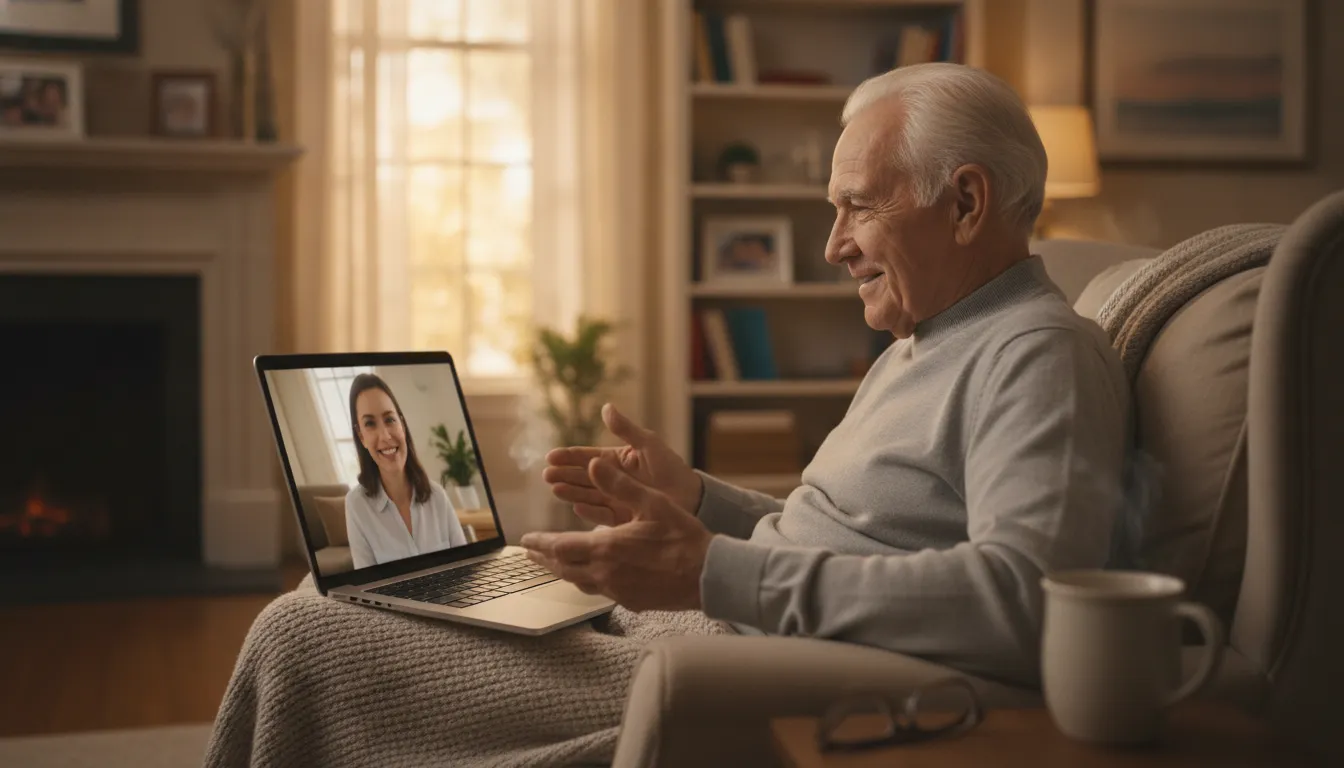
What an individual teletherapy session may feel like
Before the first appointment, the senior can choose a private, comfortable place at home and use a phone, tablet, or computer with an internet connection. A trusted family member may help with the technology beforehand if needed, while the session itself remains an individual conversation between the senior and therapist. The goal is not to perform grief correctly or provide a polished account of what happened. It is to create a safe, non-judgmental setting where the older adult can speak honestly about the loss and its effects.
At the beginning, the therapist may ask how the senior has been feeling since the last contact, what has been hardest recently, and what brought them to counseling. The senior can describe memories, loneliness, anger, numbness, fear, or the changes that have occurred since the death. If talking about the loss feels too painful at first, the therapist can begin with the senior’s daily routine, sleep, relationships, or immediate concerns. Individual teletherapy for grief is responsive to the person’s pace rather than a fixed script.
As sessions continue, the therapist may help the senior identify emotions that feel tangled together. Understand how the loss has affected daily life, and develop coping skills for difficult moments. Counseling can validate the person’s unique grief experience, support the processing of complex emotions, and help build ways to adapt to changed circumstances. Blue Moon Senior Counseling provides counseling for grief and loss through a private virtual setting designed for older adults.
Why staying home can make support more possible
Travel can be a serious barrier after a loss. A senior may no longer drive, may have difficulty walking, or may feel unable to manage a long trip while grieving. Transportation problems can cause missed appointments or lead someone to forgo professional support entirely. Teletherapy helps bridge that gap by bringing the appointment into the home, without requiring the senior to spend emotional and physical energy preparing for travel. This accessibility is important for seniors with mobility challenges and can help them receive needed grief support instead of postponing it.
Being at home can also make it easier to settle before and after a session. An older adult can keep water, medication, a familiar chair, or a comforting routine nearby. After discussing a painful memory, they do not have to immediately return to a waiting room, navigate traffic, or make a difficult journey home. They can take a few quiet minutes, contact a trusted person, or follow a simple plan for the rest of the day.
Although teletherapy does not erase grief, regular individual support can reduce the sense of facing it alone. A private virtual session gives a senior room to be heard, ask questions, and work through complicated emotions with a trained counselor. For eligible clients, Blue Moon offers individual teletherapy as a Medicare Part B covered service. That combination of privacy, accessibility, and continuity can make reaching out feel more manageable during a profoundly painful time.
How Caregivers Can Support a Senior Experiencing Complicated Grief
Supporting a grieving senior does not mean finding the perfect words or taking away the pain. Grief is personal, and the relationship they had with the person who died shapes how they mourn. The most helpful role is often steady companionship: making room for difficult feelings, noticing changes, and offering support without pressure.
These steps can help family members stay present while respecting the senior’s pace:
- Listen without trying to fix the loss. Invite them to tell you how they are doing, then give them time to answer. You do not need to explain why they feel this way, compare their grief with someone else’s, or insist that they focus on the positive. Simple responses such as, “I can see how much you miss them,” can communicate care without minimizing the loss. A support network can reduce isolation, which is especially important when a senior is spending more time alone.
- Make it safe to talk about the person who died. Say their name and welcome memories, stories, photographs, or familiar traditions if the senior wants to share them. Some older adults worry that talking about their loved one will burden others. Let them know that you are willing to listen, while also accepting that they may not want to talk every time. Grief is an individual process, so avoid suggesting that they should be finished mourning by a certain date.
- Encourage gentle routines and meaningful activities. Offer practical companionship for meals, short walks, errands, faith practices, hobbies, or visits with trusted friends. A simple daily routine can provide structure when everything feels unsettled. Meaningful activities should be invitations, not demands. Allowing pain, talking with supportive people, and gradually returning to activities they value can all support coping, but patience matters.
- Watch for changes in mood, sleep, appetite, and energy. Notice patterns rather than reacting to one difficult day. Persistent changes in sleep, appetite, or energy deserve attention, and grief can worsen depression or another existing mental health condition. If the senior seems increasingly withdrawn, hopeless, unable to manage daily needs, or overwhelmed, share what you have observed with compassion. You can review guidance from the National Institute on Aging together.
- Offer help connecting with professional support. Ask what kind of help would feel comfortable, and offer to research options, make a call, or sit nearby during a teletherapy appointment. Avoid presenting counseling as a punishment or proof that they are grieving incorrectly. A qualified professional can provide a private setting to process the loss and develop coping strategies. If there are immediate safety concerns, contact emergency services or a local crisis resource right away.
Call 630-896-7160 to speak with a grief counselor
Frequently Asked Questions
What are the symptoms of complicated grief in seniors?
Common signs include intense longing for the person who died, difficulty accepting the death, persistent preoccupation with the loss, and feeling emotionally stuck. Changes in sleep, appetite, energy, or daily routines also deserve attention, especially when they continue or interfere with ordinary responsibilities.
How does complicated grief differ from normal grief in older adults?
Grief is individual, and painful feelings can come and go for a long time. With complicated or prolonged grief, the distress remains severe, does not gradually soften, and makes daily functioning difficult for six months or longer. Mental health organizations recognize prolonged grief disorder as a real clinical condition, distinct from typical mourning. You can read more in the Association for Behavioral and Cognitive Therapies fact sheet on complicated grief.
What are the risk factors for complicated grief in seniors?
Grief is more likely to become complicated when an older adult has little social support or has had depression or anxiety in the past. It can also be harder when a senior loses a spouse or another person who provided emotional stability, or when the loss comes suddenly or unexpectedly. Advancing health problems and a sense of isolation can also make it harder for grief to soften over time. Knowing these factors does not mean grief will become complicated; it simply means that extra support may be especially helpful.
Can teletherapy help seniors coping with complicated grief?
Yes. Individual teletherapy gives an older adult a private setting to talk through the loss, understand difficult emotions, and develop coping skills without traveling to an office. Phone or video sessions can be especially helpful when driving, mobility, health, or transportation makes in-person care difficult.
How can caregivers support a senior experiencing complicated grief?
Listen without rushing the person to feel better, and acknowledge that their loss is real. Encourage gentle routines, regular contact with supportive people, and meaningful activities when they are ready. If grief remains overwhelming or affects sleep, eating, safety, or daily care, help the senior connect with a qualified mental health professional. A counselor who works specifically with older adults can offer a steady, private place to sort through the loss at their own pace.
Ready to Schedule Support for Grief?
Individual teletherapy can give an older adult a compassionate, private space to talk through loss, understand difficult feelings, and build coping skills at a comfortable pace. Blue Moon Senior Counseling provides individual teletherapy delivered by licensed clinicians who specialize in the challenges of later life. And it is provided as a Medicare Part B covered service.
You do not need to have all the answers before reaching out. To schedule a consultation, call 630-896-7160. A caring conversation can help you or your loved one take the next step toward support after a loss.