

Volunteering and mental health in older adults can be connected in meaningful ways. A chosen volunteer role may offer routine, social contact, and a chance to contribute, but it is not a cure for depression, anxiety, grief, or loneliness. The best fit is one that feels worthwhile and manageable for the person doing it.
Request individual teletherapy support or Call Blue Moon Senior Counseling at (630) 896-7160
How can volunteering and mental health in older adults connect?
Volunteering can add structure to a week and create regular contact with other people. It can also give someone a role beyond being a patient, retiree, or family member who needs help. Those experiences may support a sense of belonging, usefulness, and connection.
Research offers reasons for interest, but it does not promise the same result for everyone. An observational study of older adults found that volunteering was associated with better psychosocial outcomes, while it did not find improvement in physical health conditions such as heart disease or diabetes. An association is not proof that volunteering caused an outcome. Read the study, Volunteering and Subsequent Health and Well-being in Older Adults, for details on its findings and limits.
Volunteer work may also help interrupt isolation when it creates regular, comfortable social contact. HelpGuide’s overview of volunteering and well-being describes potential benefits such as support for well-being and relief from feelings such as stress or anxiety. That broad guidance is not a substitute for clinical care, and a volunteer role should not be presented as treatment. For an individual, the effect depends on personal interests, health, energy, access, and the quality of the experience.
What can volunteering offer beyond a busy calendar?
A useful role is not necessarily a demanding one. For some older adults, a small, predictable commitment can bring more value than a long list of activities. Consider what the person hopes to gain:
- Regular connection: A recurring shift or check-in can create a reason to see familiar people.
- A sense of contribution: Sharing a skill or helping with a practical task may reinforce that a person still has something to offer.
- Structure: A set time can give shape to otherwise quiet days, especially after retirement or a major life change.
- Learning and interest: Some roles offer a new skill or connect with a long-standing interest.
- Purpose: Helping with a cause that matters to the volunteer can make time feel connected to personal values.
These possibilities are individual, not guaranteed outcomes. One person may feel energized by a lively group setting; another may prefer a short task completed from home or a quiet one-to-one activity. The goal is not to meet someone else’s idea of an active retirement. It is to find a role the older adult actually wants to try.
How can an older adult choose a role that fits?
Start with preferences and practical limits, not with the organization that has the most urgent request. A role is more likely to remain comfortable when the expectations are clear and the person has a real choice about taking part.
- Name the interest. Ask what the person enjoys or cares about: animals, reading, gardening, local history, faith or community activities, mentoring, or helping neighbors. The answer can be “nothing on that list.” Explore without pressure.
- Decide what kind of contact feels good. Would they rather work independently, meet a small number of people, or join a larger group? Do they prefer a task with a clear beginning and end?
- Set a realistic time limit. Agree on a trial commitment, such as one short shift or a single event, before considering a recurring schedule. Leave room for rest, appointments, family responsibilities, and days when energy is lower.
- Check access and logistics. Ask about transportation, parking, stairs, restroom access, noise, schedule changes, and whether tasks can be adapted. If travel is difficult, look for a role that can be done by phone, online, or close to home.
- Clarify the expectations. Find out what training is required, who will be present, what the volunteer is responsible for, and how to cancel or take a break. The organization should be comfortable answering these questions.
- Try it, then review. After the first visit, ask what felt enjoyable, tiring, confusing, or uncomfortable. Adjust the role or stop if it is not a good fit.
It can help to make the first step small and reversible. A family member might offer to help find contact information or arrange transportation, then let the older adult decide whether to proceed. Ask before taking over. Preserving choice matters as much as finding an activity.
After a first visit, the older adult can take a minute to reflect: Did the activity feel worthwhile? Was the social contact comfortable? Did the travel or schedule take more energy than expected? Would a shorter shift, different task, or another organization improve the fit? A quick conversation or a few private notes can make it easier to decide based on the experience rather than on pressure to keep going.

Which volunteer options may feel manageable?
There is no single right kind of volunteering. Some options involve a regular shift; others are occasional or task-based. The comparison below can help a person think through fit. Actual duties, schedules, and accessibility vary by organization, so confirm details before committing.
| Type of role | Potential fit | Questions to ask |
|---|---|---|
| Short, scheduled shift | Someone who likes routine and in-person social contact | How long is a shift? Is seating available? Can the schedule be changed? |
| One-time event | A person who wants to try an activity without an ongoing commitment | What is the time commitment? Is there a clear contact person? |
| Remote or phone-based task | Someone who prefers to stay home or has transportation barriers | What equipment or training is needed? Can the task be done at a flexible time? |
| Skill-sharing or mentoring | A person who wants to pass on experience or knowledge | Who will participate? What boundaries and preparation are expected? |
| Practical community help | Someone who prefers a specific, concrete task | Is the task physically comfortable? Who handles lifting, travel, or supplies? |
Before agreeing to a role, it may help to write down a few boundaries. For example, a person might be comfortable with a two-hour commitment once a month, but not with last-minute requests or heavy lifting. Having a clear limit makes it easier to explain what will and will not work.
- How many hours or visits feel reasonable to try?
- What physical tasks should be avoided or adapted?
- Does the person want someone to accompany them on the first visit?
- What is the easiest way to let the coordinator know they need to cancel?
Imagine a retired teacher who misses helping students but has limited stamina. Rather than taking on a full weekly schedule, they could ask whether a short, occasional reading or mentoring role is available, what preparation it involves, and whether they can sit during the activity. The example is not a prescription; it shows how a past interest can be translated into questions about the actual role.
The right match includes the organization’s culture, not only the task. A welcoming coordinator who respects a volunteer’s limits can make a meaningful difference. If the role brings pressure, conflict, or exhaustion, the volunteer is allowed to ask for changes or leave.
When can volunteering become too much?
Helping others should not require someone to ignore their own needs. A commitment may need to change if it repeatedly leaves a person exhausted, interferes with medical appointments or rest, causes dread, or brings more pressure than satisfaction. A person managing illness, grief, caregiving, or a recent transition may have limited capacity even if the cause matters deeply.
Research on older adult volunteers also considers how volunteering fits alongside other roles. A study from the University of Maine describes caregiving as a role that can affect health and well-being and examines the experience of older adults balancing multiple roles. Its subject is useful to keep in mind: volunteering is one part of a person’s life, not an obligation to add on top of everything else. See the older adult volunteer study for its focus.
Signs that a commitment may need adjusting include:
- The person often feels depleted for the rest of the day after volunteering.
- The schedule crowds out sleep, personal care, appointments, or time with close relationships.
- The volunteer feels unable to say no, even when a request is beyond their ability.
- The role creates persistent worry or worsens sadness rather than offering a welcome connection.
- Transportation, costs, or physical demands are becoming difficult to manage.
Try reducing the frequency, shortening a shift, changing tasks, or taking a break. A trusted clinician can help consider how mood, health, and life circumstances affect energy and motivation. For older adults coping with caregiver stress, it can be especially important to make room for support rather than adding another duty.
Explore counseling options for an older adult
What if an older adult feels lonely or low but is not ready to volunteer?
Volunteering is only one possible route to connection. It may not suit someone who is grieving, anxious about meeting new people, physically tired, or simply uninterested. Avoid treating reluctance as a problem to overcome. Ask what would feel safe or worthwhile now: a call with a friend, a brief visit, a familiar hobby, a faith or neighborhood connection, or support from a counselor.
Families can offer options without turning them into assignments. For example, say, “Would you like me to look into one short shift, or would you rather talk about other ways to feel more connected?” Give time for an answer. If a first attempt does not work, that is useful information, not failure.
Persistent sadness, anxiety, loss of interest, or difficulty managing everyday life deserves attention beyond an activity recommendation. Learn more about counseling for anxiety or ways to cope with loss. These pages can help families consider whether professional support may be a useful next conversation.
How can families support volunteering and mental health in older adults?
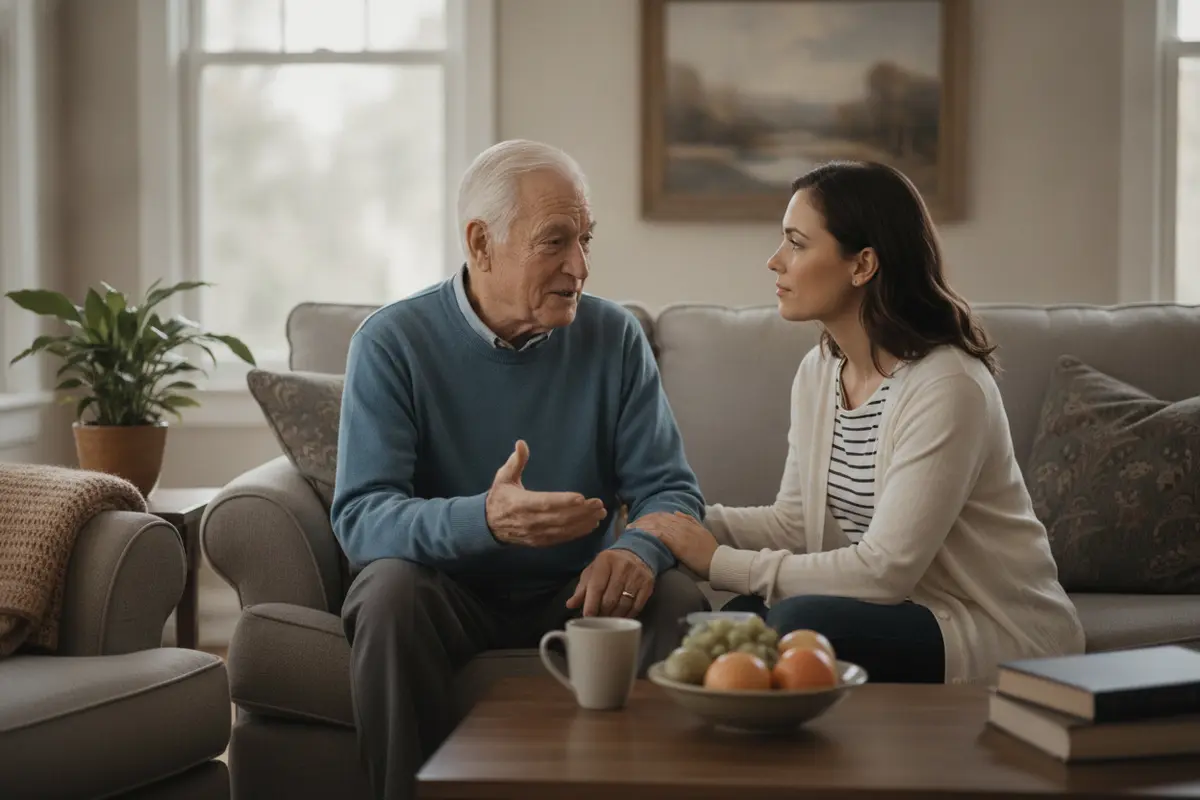
Adult children and other caregivers can support exploration while keeping the older adult in charge. Try these approaches:
- Ask before researching or arranging. An offer of help is different from assuming the person wants a role.
- Use open questions. “What kind of activity sounds pleasant?” is more inviting than “You need to get out more.”
- Make logistics easier when invited. Help compare schedules or arrange a first visit, but let the person speak for their own preferences.
- Agree on a check-in. After an initial activity, ask how it felt rather than whether the person will continue.
- Respect a no or a change of mind. A person can decline a role, pause, or choose a different way to connect.
For more ideas about rebuilding connection after a transition, see this guide to social connection for older adults. If an older adult wants to explore counseling, Blue Moon Senior Counseling offers individual teletherapy for seniors by phone or video as a Medicare Part B covered service. Original Medicare and most Medicare PPO plans may cover the service, while HMOs do not cover our service; coverage should be checked for the person’s specific plan.
Request individual teletherapy support or Call Blue Moon Senior Counseling at (630) 896-7160
Frequently Asked Questions
Does volunteering prevent depression in older adults?
No. Volunteering may support social connection and purpose for some people, but it is not a proven way to prevent or treat depression. Ongoing low mood, loss of interest, or distress should be discussed with a qualified health professional.
How often should an older adult volunteer?
There is no universal schedule. Start with an amount that fits the person’s energy, health, responsibilities, schedule and preference. A one-time event or short shift can be a reasonable way to explore before making a recurring commitment.
What if transportation or mobility makes volunteering difficult?
Ask organizations about seated tasks, short shifts, accessible locations, remote work, or phone-based roles. Confirm the exact requirements rather than assuming a role can be adapted. It is also reasonable to choose a different way to connect.
Can counseling and volunteering both be part of an older adult’s support?
They can serve different purposes. Volunteering may offer activity and social contact; individual counseling can provide a private place to discuss concerns such as grief, anxiety, or adjustment. A clinician can help the person consider what support fits their situation.
Choosing a next step
Volunteering can be a meaningful part of life in later years when it reflects the person’s interests and respects their limits. Start with curiosity, choose a manageable first step, and reassess honestly; connection and support should make room for the older adult’s own priorities.